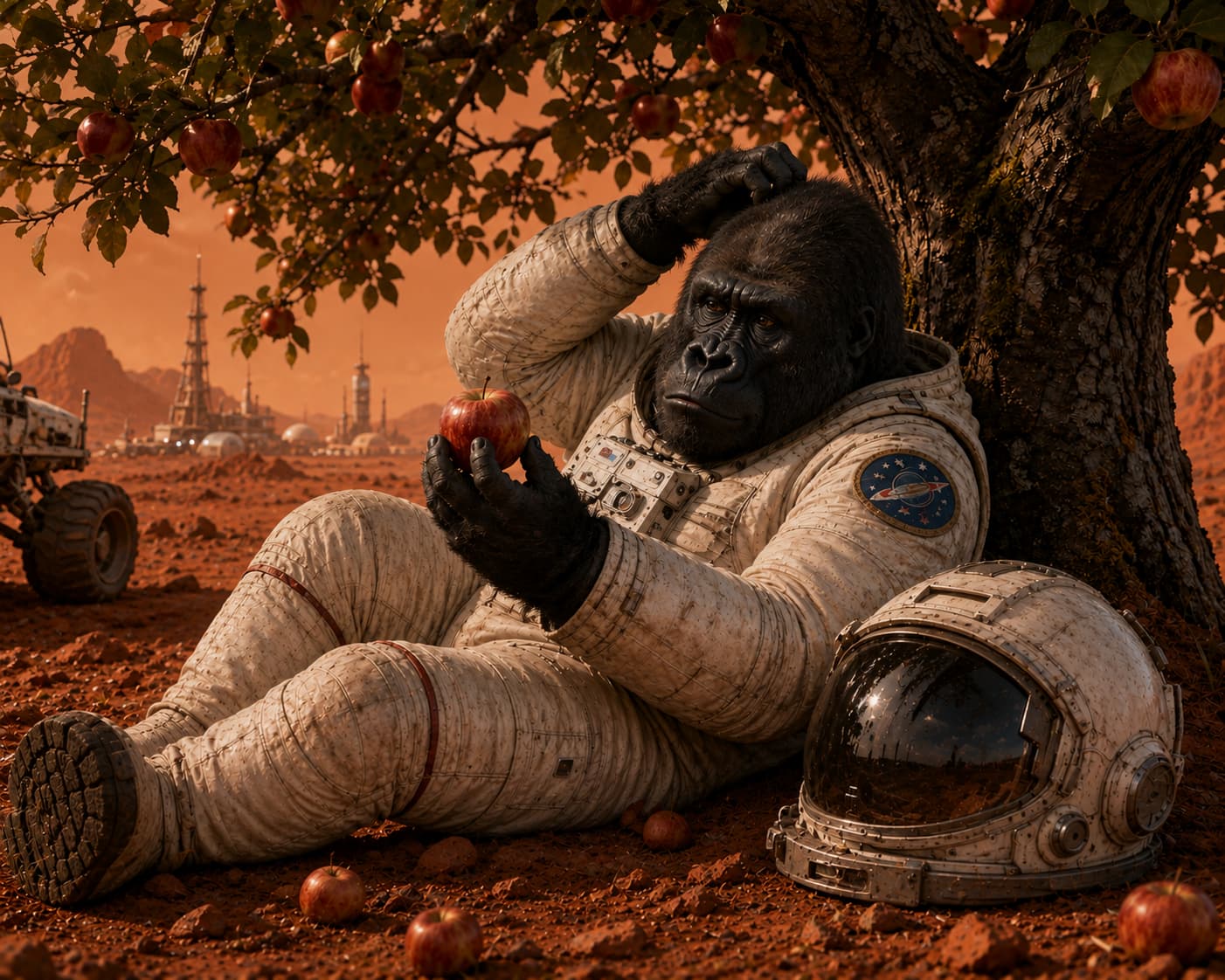
The news is full of rocket ships and tales of companies facing challenges and breaking barriers. The latest example: a new version of SpaceX Starship that flew yesterday. As that product matures, SpaceX will experiment with orbital refueling, allowing the company to send "tankers" with liquid methane and oxygen into space to extend the range. Those in the know, such as James Burk, Executive Director of The Mars Society, predict manned landings on Mars are about five years out from that point.
Prices for ships and space operations continue to fall. This is tremendously exciting and sets the stage for an increased pace of human exploration in space. It provokes analogies to European exploration and colonization centuries ago of what, to them, represented a New World. But consider how, for humans with their frail bodies, navigating space differs from sailing the sea. The oceans were indeed unforgiving. They offered little nutrition and no fresh water, save what you carried or what rain fell upon you. But terrifying though the sea could be, there was a chance to reach land where you could breathe, grow crops, and find relief from the brutal sun. Space takes the lethality of oceans to a fiendish level. Studies show that the human body is damaged by time there, both by radiation and the effects of low gravity. So what is the probability that, after some exploration and the installation of infrastructure, humans can succeed should they choose to live on Mars?
Radiation is the easier evil to avoid. Medicines help the body cope with damage. Living quarters can be heaped with dirt for shielding or located underground. Time outside can be limited, bodies monitored for exposure, and power expended to maintain a magnetic bubble over living quarters and working areas. Given enough resources, a shield might be extended over a large portion or even all of the planet.
The same cannot be said for Martian surface gravity, about 38% of Earth's level. Once you go, you're stuck with it for the duration. What happens to complex organisms that inhabit such a place? They live, but do they thrive, and can they function indefinitely? The answers so far are not entirely clear. Much work remains, but it's evident that the challenge is daunting.
A recent review of scientific literature illustrates the astonishing extent to which gravity affects human systems. Reproduction in microgravity will be difficult and perhaps unethical for humans. Is the same true of 1/3 Earth gravity? That's not yet known. Deleterious effects on muscle tissue, immune functions, and other systems abound. The good news is that continuous exposure to 2/3 Earth gravity is enough to prevent those. Intermittent exposure to higher artificial gravity might also do the trick, and that can be researched. If that proves to be so, you can add it to the long list of things you have to do to live on Mars. Hey, Mars is tough! You gotta want it. The gorilla can be tamed if you respect it and work with it.
Kevin Kelly, May 23, 2026